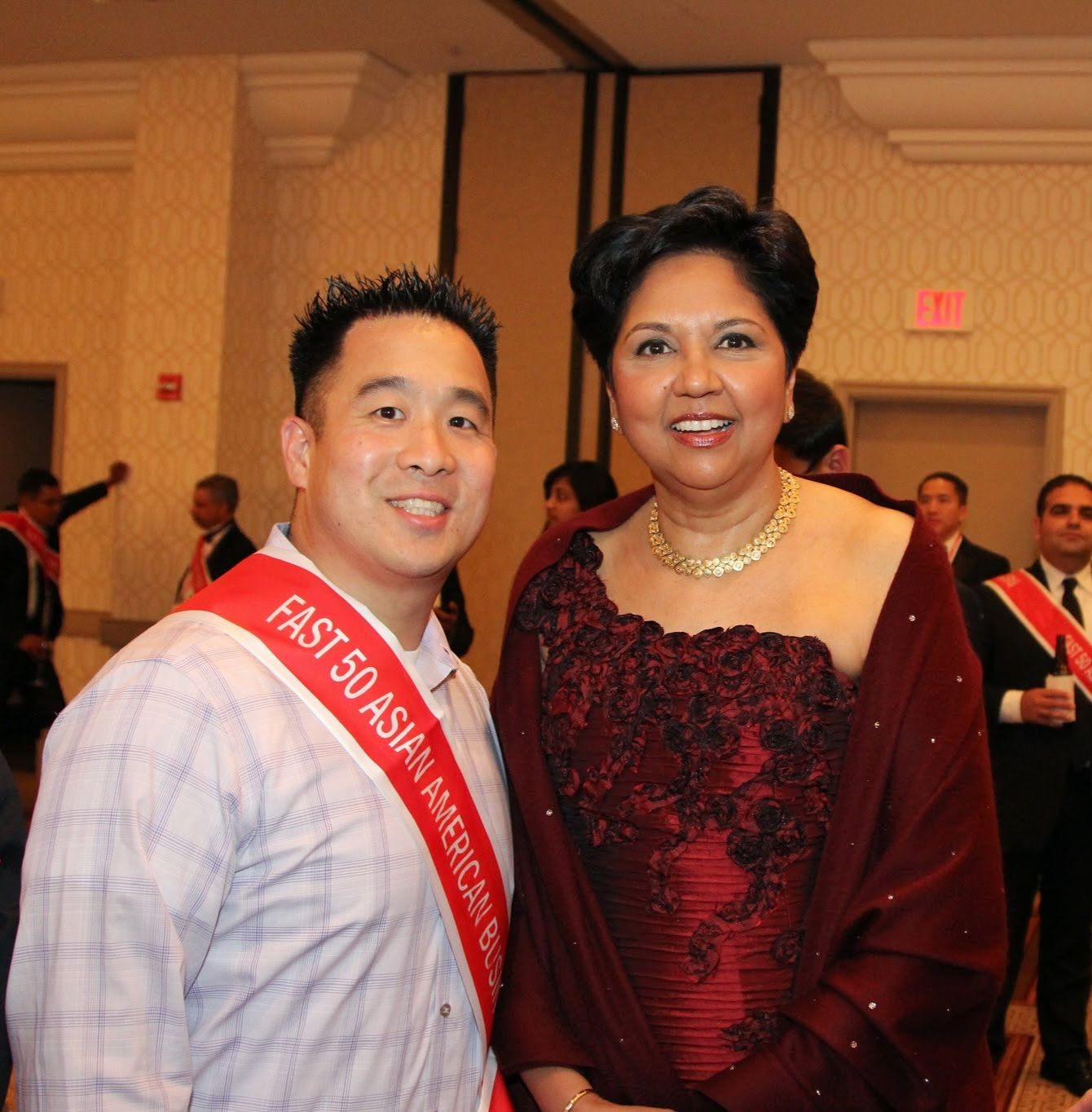
In 2014, I was named to the Fast 50 Asian American list. The awards dinner was in Washington DC. It is a list I'm more proud of than almost any other recognition I've received, and it has nothing to do with rank or ceremony. It has to do with the fact that I grew up in a country and a working culture where there weren't many people who looked like me in the rooms I was trying to get into. Being recognized by a community of Asian American entrepreneurs and executives — by my community — felt different than any list Inc. ever put me on.
The keynote speaker that night was Indra Nooyi. For those who don't know the name, she was the CEO of PepsiCo at the time. Indian-born, American-built, a woman in a room full of men, a South Asian immigrant in a role historically held by white American men, and — by every account — one of the most disciplined operators any Fortune 50 company has ever had. If you've read her memoir My Life in Full, you already know the outline.
After her speech I had 90 seconds with her in the receiving line. I know it was 90 seconds because I counted. I've replayed those 90 seconds so many times I know them by heart.
The wrong question I almost asked
I had been rehearsing a question in my head all through dinner. It was the question every ambitious operator has asked every powerful executive since the beginning of time. Some version of: "What's your advice for someone at my stage?"
It's not a bad question. It's just a useless one. Powerful people get asked it 50 times a week. The answer they give is almost always a polished version of something they've said on a podcast or in a magazine profile. You walk away with a sentence that feels meaningful in the moment and evaporates by the time you get back to your hotel room.
I was two seconds from asking it when I caught myself. I don't know why. Maybe because I was wearing the Fast 50 Asian American sash and the weight of that sash made me want the 90 seconds to be worth something. Maybe because my wife would have been mad if I wasted the moment. Maybe because something in Indra's face told me she was tired of advice-seekers and would genuinely reward a different kind of question.
So I asked this instead:
"Looking back, what's the tradeoff you made that you wish you hadn't?"
Her expression changed. Not dramatically. Just a little. The polite-CEO smile softened into something more real. She paused for what felt like a long time. Then she answered with about six sentences. I am not going to reproduce them here, because I want to respect the privacy of a private conversation in a receiving line. But I will tell you what the answer was about, because the shape of it is what mattered to me.
The shape of her answer
Her answer was not about career strategy. It was not about sacrifice-it-all for the corner office. It was not a polished talking point. It was about family. About the years you do not get back. About the first steps and the school plays and the small Tuesday-night dinners that blur together for a person in a demanding C-suite role until one day the child who was six is suddenly sixteen and the window has closed.
I was not expecting that answer. I was expecting an operating lesson. What I got was a life lesson, delivered by one of the most operationally credentialed people on the planet, in 90 seconds, to a 30-something Korean American founder wearing a ceremonial sash at a hotel in DC.
I walked back to my table, sat down, and did not speak to the person next to me for the rest of the meal. Not because I was sad. Because I was busy reorganizing the weights inside my own head.
Why that moment has stayed with me
1. Representation actually matters
I want to say this gently because it is a phrase that has been weaponized in directions I don't love. But here is what I mean by it: when you grow up as a minority in a business culture that doesn't reflect you, the first time you see someone who looks like you sitting in a seat you aspire to, something inside your nervous system actually changes. It is not a political statement. It is a physiological one. I felt it in 2014 at that Fast 50 Asian American dinner, watching Indra give that keynote. I feel it now, at almost-50, walking into boardrooms in Korea, Singapore, Tokyo, and São Paulo, trying to be one of the people who makes the next version of that feeling possible for someone else.
2. Ask the question people are not asking them
If you get 90 seconds with someone extraordinary, don't ask for advice. Ask for regret. Ask for tradeoff. Ask for the thing they wish they had done differently. You will learn more in those 90 seconds than you would from reading their entire LinkedIn. The advice questions get the canned answer. The regret questions get the real one.
3. Legacy is not what you build. It is what you protect.
This is the part of Indra's answer I'm still carrying. I built a company. I took it public. I sold companies. I'm building new ones now. Those are achievements. They are not my legacy. My legacy, if I am honest, is a 3-year-old toddler — the Monday-night dinners, the math homework, the Back 9 of my own life spent at his actual 6-year-old speed instead of 35,000 feet over the Pacific on my way to another board meeting. She gave me that lens in 90 seconds, a decade before I was ready to hear it.
A note about the Fast 50 Asian American list
I want to say one more thing, because the piece would feel incomplete without it. The Fast 50 Asian American recognition itself meant more to me than I can easily explain in an English sentence. I am Korean American — born in one culture, built in another, operating professionally in rooms where my accent and my face and my last name are usually the only ones of their kind. My parents came to this country with a specific kind of hope, and lists like this are one of the few places where that hope gets to be visible.
I don't talk about it often because it doesn't fit neatly into a business framework. But if any younger Korean American, Chinese American, Indian American, Japanese American, or Vietnamese American founder is reading this — if you're one of the kids in a room where nobody looks like you — I want you to know that the recognition isn't the point. The recognition is the artifact. The point is that you, specifically, are allowed to take up the space. You are allowed to walk the receiving line. You are allowed to ask the unexpected question. You are allowed to hear the real answer.
Your challenge
Here is what I want you to do this week. Think of the most accomplished person you have access to — not the most famous, the most accomplished — and write down the question you would ask them if you had 90 seconds. Not the advice question. The regret question. The tradeoff question. Write it down. Carry it with you. Then use it the next time you find yourself face to face with that person.
The 90 seconds might give you what the next ten years of reading business books couldn't. Indra gave me exactly that, in 2014, in a hotel ballroom in DC, wearing the Fast 50 Asian American sash. I am still grateful for it, and I am still writing about it a decade later — which is the best evidence I can give you that the question was worth asking.